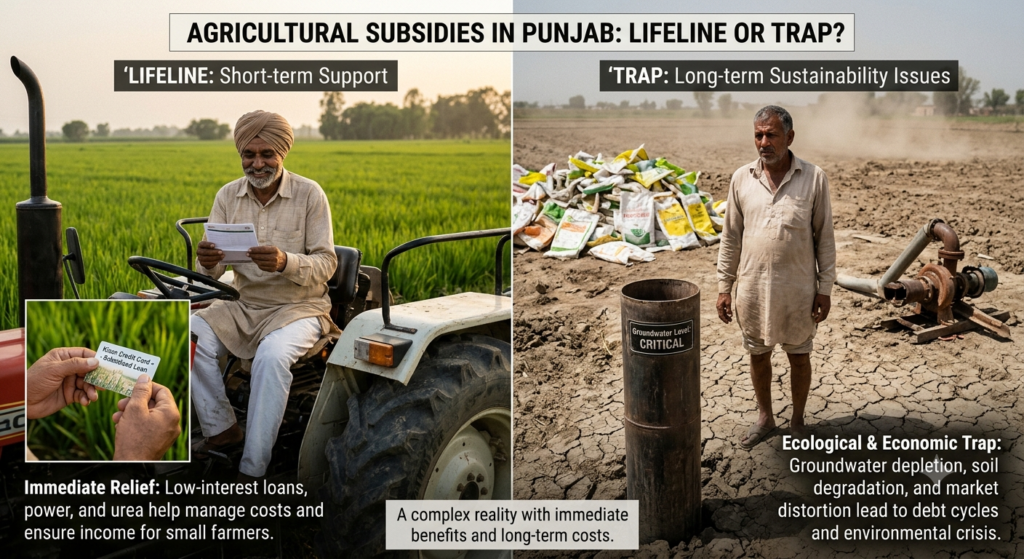

Agricultural Subsidies in India: Are Farm Subsidies in Punjab a Lifeline or a Trap?
Few policy issues divide farmers, economists and voters as sharply as subsidies for agriculture in India. A subsidy can mean the difference between a profitable season and a loss for a smallholder. To a policy analyst, the same subsidy can seem like a slow leak of water, soil and public finances. Punjab, the country’s bread basket, is the only state where the two sides are more visible.
This analysis provides evidence for each view without taking sides with any government or party.
Why Agriculture Subsidies in India Exist
Farming is exposed to weather, price swings and input costs that individual farmers cannot control. Governments intervene for four broad reasons:
- Food security: India needs stable grain supplies for its public distribution system.
- Income support: Farm incomes are low and volatile compared with other sectors.
- Affordable inputs: Fertiliser, power and water are kept cheap so small farmers can use them.
- Price stability: Assured procurement reduces the risk of a price crash after harvest.
Types of Agricultural Subsidies
Support reaches farmers through several channels:
- Fertiliser subsidy: The government pays part of the cost so farmers buy fertiliser below market price. The Union Budget 2026-27 provided a net allocation of about ₹1.71 lakh crore to the Department of Fertilisers.
- Power subsidy: Electricity for irrigation pumps is free or heavily discounted in several states.
- Irrigation subsidy: Canals, tube-well support and, increasingly, micro-irrigation schemes.
- MSP-linked procurement: Government agencies buy wheat and paddy at announced Minimum Support Prices, based on recommendations from the Commission for Agricultural Costs and Prices (CACP).
- Credit and interest subsidies: Concessional farm loans, such as the Modified Interest Subvention Scheme.
- Direct benefit schemes: PM-KISAN pays ₹6,000 a year in three instalments of ₹2,000 directly to bank accounts. Its Budget 2026-27 allocation is ₹63,500 crore.
How Subsidies Support Farmers’ Incomes
Subsidies are working on both sides of the farm ledger. Cheaper inputs mean lower cultivation costs. Guarantyd procurement protects the selling price. Together they give farmers a predictable margin and so encourage investment in seed, machinery and land.
A direct transfer like PM-KISAN provides a small, regular flow of cash which helps in meeting seasonal expenses. Even a small support for marginal farmers can reduce their dependence on informal money lenders.
Punjab’s Case: Free Power and Assured Procurement
Punjab’s model is based on two pillars. The first is assured procurement of wheat and paddy, which gave farmers confidence to adopt high-yielding varieties and helped make the state a major contributor to the national grain stock.
The second is free electricity to the farmers. Free farm power was introduced in the late 1990s and successive governments have continued it. Punjab Budget 2026-27 allocated ₹7,715 crore for free power to farmers. The state will spend about 12.3% of its budgeted revenue receipts, or ₹15,550 crore, on all power subsidies in 2026-27, according to PRS Legislative Research. That total is more than farm consumers. newkeralaprsindia
Together, these policies explain much of what farm subsidies have done for Punjab, and what they now cost.
Unintended Effects
Depletion of groundwater. If it costs the farmer little to pump electricity, there is little reason to conserve water. Paddy is a water-hungry crop and a large part of Punjab’s paddy is irrigated from tube wells. The Central Ground Water Board’s 2024 assessment found annual extraction to be 27.66 billion cubic meters against an extractable resource of 17.63 billion cubic meters, a stage of extraction of 156.87%. Later official data show a slight improvement, but extraction is still well above sustainable levels. Rainfall, canal supply and cropping patterns also affect these trends, so subsidies are one of many factors. Central Ground Water Board (CGWB)
The health of soils and the over-application of fertilisers. When nutrients are cheap, farmers may overapply nutrients, or apply them in unbalanced ratios. Some areas have long been identified by experts as high nitrogen users. The picture is different in each district so readers should consult with the Ministry of Agriculture and state soil-health data.
Monoculture. The certainty of wheat-paddy procurement makes other crops look riskier. This over time reduces the diversity of the cropping pattern, making it less resilient to pests, climate stress and market shocks.
Fiscal load. Recurrent subsidies compete with expenditure on health, education and infrastructure. Whether the burden is acceptable is a judgement call, but it is a real trade-off for any state budget.
The “Lifeline” Argument
Supporters make four main points:
- Farming is risky, and for many households subsidies are the only buffer against loss.
- Assured procurement and cheap inputs have helped India avoid the food shortages of earlier decades.
- Costs of cultivation keep rising, and without support many small farms would become unviable.
- Farmers in other countries also receive substantial public support, so cutting support unilaterally could leave Indian farmers at a disadvantage.
The “Trap” Argument
Critics make a different case:
- Subsidies that reward one or two crops lock farmers into them, even as the water table falls.
- Input subsidies are tied to use rather than outcomes, so they can encourage overuse.
- Recurring payments are hard to withdraw. Farmers organise their cropping and finances around them, which makes later reform politically difficult.
- Fiscal space spent on subsidies cannot be used for irrigation, storage, research or market infrastructure, which might raise incomes more durably.
Who Benefits Most?
Benefits are uneven. Because input subsidies scale with consumption, farmers with larger holdings, more irrigated land and more pumps tend to receive more. Procurement mainly benefits farmers who grow the procured crops and have access to mandis. Tenant farmers and those in regions with weaker procurement may receive far less. Studies by NITI Aayog and the CACP have discussed these distributional questions, and readers should consult the original reports for exact estimates.
Reform Options Experts Have Discussed
|
Subsidy Type |
Intended Benefit |
Unintended Effect |
Reform Option |
|
Fertiliser subsidy |
Affordable nutrients, higher yields |
Unbalanced and excess use; soil stress |
Rationalise input subsidies; promote balanced nutrient use and soil testing |
|
Free or subsidised farm power |
Cheap irrigation, lower costs |
Over-pumping; groundwater decline; state finance strain |
Metering, feeder separation, direct benefit transfer for power |
|
Irrigation support |
Reliable water supply |
Water-intensive cropping persists |
Efficient irrigation (drip, sprinkler), canal revival |
|
MSP-linked procurement |
Price assurance, food security |
Wheat-paddy concentration |
Crop diversification incentives; wider procurement of alternatives |
|
Credit and interest subsidies |
Cheaper farm credit |
Benefits skew to better-connected borrowers |
Better targeting and wider formal credit access |
|
Direct benefit schemes (PM-KISAN) |
Income support, less leakage |
Fixed amounts may not reflect land size or need |
Improved beneficiary data; tenant inclusion |
Experts have discussed several directions for subsidy reform for farmers:
- Direct benefit transfer: Giving farmers cash instead of subsidised inputs, so they choose how to spend it. Critics worry about adequacy and targeting.
- Diversification incentives: Paying farmers to shift from paddy to maize, pulses or oilseeds, ideally with assured purchase.
- Efficient irrigation: Drip and sprinkler systems that cut water use per crop.
- Rationalising input subsidies: Aligning fertiliser and power support with sustainability goals.
Any change needs sequencing, because abrupt withdrawal could hurt farmers who have planned around current support. Several of these ideas appear in discussions of free electricity for farmers, including options that preserve income support while introducing incentives to use less water.
Conclusion
The farm subsidies in Punjab are not a pure lifeline or a pure trap. They have underpinned farm incomes and secured food supplies, but also contributed to groundwater stress, crop concentration and fiscal pressure. The question is less whether we should support farmers and more how we should support them in a sustainable manner.
For those looking for a more farmer-centric view of agriculture subsidies in India, the agriculture subsidies in India resource is a good place to start. Whatever the view, the safest course is to go back to the original budget documents, CACP reports and CGWB
FAQs
The major categories include fertiliser, power, irrigation, procurement linked to MSP, credit and interest subsidies and direct benefit schemes, such as PM-KISAN.
Punjab has promised procurement of wheat-paddy and free farm electricity. It also has some of the highest levels of extraction of groundwater in the country. It is thus a prime test case for subsidy reform.
The cost of pumping is reduced by free power and this may incentivise heavy extraction. It is one factor and not the sole cause, as cropping patterns, rainfall and canal supply also matter.
Not always. Experts discuss it as an option, mainly for inputs like power and fertiliser. Its success depends on numbers, targeting and farmer confidence.
Use Union Budget documents, Punjab Budget documents, CACP reports, and Central Ground Water Board assessments. The data each year changes the allocations and the extraction level.