

Election Manifestos: A Policy Document or a Catalogue of Freebies?
Does the promise-laden run-up to Punjab’s elections point to a brighter future?
Punjab is once again edging toward an Assembly election. Leaders big and small are travelling from television studios to village lanes in search of votes, and many of the faces are ones the voters has not seen for four years. Five parties dominate the field: the Aam Aadmi Party, the Congress, the Shiromani Akali Dal, the BJP and the Shiromani Akali Dal (Waris Punjab De).
The contest is not only between parties. Within them, the tug-of-war over chairs is just as fierce. The difference is that when one party’s fortunes fall, another’s improve. AAP is busy counting its achievements while facing public anger. The Congress, tangled in its own factional quarrels, ignored the real issues for years and has only now found a flicker of hope. The BJP has left the Akali Dal in an awkward spot: any issue it takes up risks setting it against the BJP, and if an alliance does form, nobody knows what will happen to the Akali candidates already in the field. The BJP, meanwhile, is promoting the Centre’s work with great enthusiasm, though it has little to show on the ground concerning Punjab. The Akali Dal (Waris Punjab De) seems limited to Panthic issues.
At a time when the sitting government is busy publicising its own record of arrests on drugs and their prevention, the ground reality tells a different story. Fresh cases surface every day, and the Congress and BJP in particular are using them to argue that drugs have not been controlled but have spread empirically. The thrashing of Mohanjit and the death of Gulzar Singh made their task easier. The murder of Parminder Singh Jhota only poured oil on the fire. Whether or not they lived long, in death they at least gained four political platforms to stand on.
Elsewhere, a professor at Khalsa College, Amritsar, raised his voice against the management for his rights, nobody listened. When he finally went to a tribunal, it heard him and reprimanded the management. The management then created such a hostile atmosphere for him that he took his own life. It is sad to say that the professor’s death failed to stir the political class, because no political camp could be drawn in behind it. The drug issue, by contrast, touches people’s hearts. Yet the truth is that education, good jobs and drug prevention are all linked, and no political party has turned its attention to this.
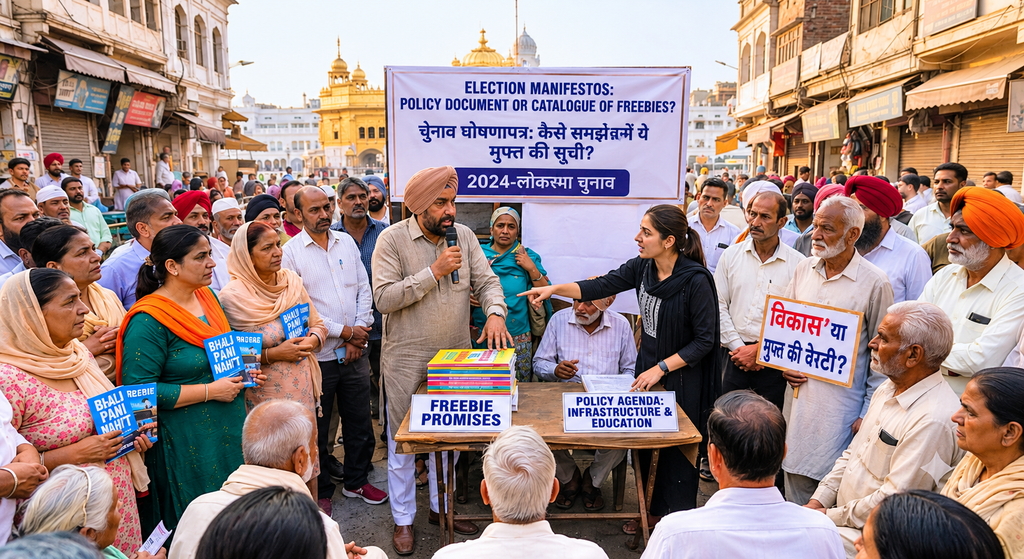
What the 2022 manifestos promised
The 2022 manifestos were dominated by drugs, sand, debt, corruption, unemployment and free facilities. The most talked-about promises in the AAP manifesto were 300 units of free electricity a month, Rs 1,000 a month for every woman over 18, waiver of old electricity bills, 25 lakh jobs, corruption-free government offices, an end to government liquor contracts and the sand mafia, life imprisonment for drug traffickers, and amnesty for the hard-hit along with tougher laws going forward.
The Congress offered women Rs 1,100 a month, eight free gas cylinders, one lakh government jobs, Rs 2,500 a month for the unemployed, an end to drugs, an end to the liquor and sand-mining mafia by setting up corporations, and an industrial policy within 90 days.
The Akali Dal–BSP alliance promised five lakh pucca houses, free plots, 800 units of free electricity, a Rs 10 lakh health insurance cover, and cheaper diesel and a promise of MSP for farmers.
The BJP alliance promised complete loan waivers for farmers with less than five acres, MSP on fruits, vegetables and pulses, a 24-hour health centre in every panchayat, Rs one lakh crore of infrastructure in five years, and fast-track courts for sacrilege cases.
Free goodies led the way in all of them. In reality, though, the farmers’ movement had just ended, and people carried old grievances against the Akali Dal and the Congress. Everyone else was looking for change and gave the new faces a chance, and people were swayed by the new slogans. Last time the voters’ focus was not on the manifesto. The one issue was to defeat the old political establishments and bring in the new. Times have changed since, and although a new front has appeared, people do not seem very pleased with how things went during the present regime.
The freebie question
Yet freebies will dominate this election too. Most households today get roughly Rs 4,000 to Rs 4,500 worth of benefits a month. That includes 300 units of electricity, which at about Rs 10 a unit works out to Rs 3,000, and Rs 1,000 to Rs 1,500 for women. Beyond that, ration-card holders now receive a free ration kit with grain and pulses along with oil, sugar, salt, chilli, tea and so on. Elders get free pilgrimages, and women, beyond pocket money, ladies can now travel free on buses.
The question that must be asked is whether people will choose Punjab’s prosperity or the free handouts for themselves. If a party that lives on freebies forms the government, what will happen to Punjab, which already has to borrow through middlemen paying hefty commission to raise a loan? On the other hand, it is hard to give up a habit once formed. Freebies are a drug that keep the voters calm and asleep.
How can Punjab win?
Whoever forms the government, Punjab needs to be pulled back from the brink. The first requirement is for people to understand that there is a dire need to rescue Punjab from debt. On the other hand no party can stop making new free promises. Drugs are today speaking loudly. Many deaths go unreported because people fear the post-mortem and the police harassment. As the elections draw closer, political parties are paying the issue more attention. In reality, though, the problem is directly connected with our own homes, and people are coming out onto the roads over it. Sadly, nobody has a definite road map to end this menace, because its roots are tied to many other problems: unemployment, a poor education system and remittances from abroad and gangsterism. Another question arises: anyone who tries to raise his or her voice against it is simply removed from this mortal world.
Nobody speaks about unemployment, deteriorating education and law and order system. Even the Enforcement Directorate, NIA, vigilance and income-tax dept fails to check, the sand mafia and liquor. The public too turned a blind eye. It seems people feel nothing will change here, so they have compromised to the situation.
Today drugs have become the biggest threat to Punjab’s very existence. Whichever party wants to win elections should not merely say it will end the drug menace by 2029 or by some other date, because people have seen how every party has performed in the past. From the behaviour of the politicians and what the people demand, it seems that once again freebies will show their colour. People have fallen into the habit of sitting idle, because there is no worry about paying bills and free electricity does not allow them to leave the comfort zone. An idle mind is the devil’s workshop, and the mind turns toward addiction. Everybody wants to be rich quickly, especially when they observe the sudden rise of their elected representatives. Yesterday they were seen on bicycles and scooters; today they are seen on fancy vehicles, and at that point a thought settles in the mind: “why not me too?” Because of such thinking and such conduct, Punjab is falling further behind by the day. Today every Punjabi needs to think about how to save Punjab’s very existence, and everyone should contribute in whatever way they can. Taking on liquor and the sand mafia in comparison to the drug prevention was easy, but even there success eluded every party. All these menace (Drugs, Sand and Liquor Mafia and Gangsterism) are on the road to progress. Only the faces change with the power of votes.
Dr. Amanpreet Singh Brar
Professor and Policy Columnist, Punjab
96537-90000