

Punjab Agricultural Economy: How Farming Shapes Punjab’s Economic and Rural Growth
By Dr. Amanpreet Singh Brar
Introduction
India’s food security rests heavily on Punjab, a state with a small land area. Farming here is more than a source of income. It sets the pace of rural markets, shapes credit and employment, and affects the state’s fiscal and environmental health. This article looks at the Punjab agricultural economy in numbers and in structure. It covers what farming contributes, where the model is under strain, and what can make rural growth more durable.
1. Agriculture’s Contribution to Punjab’s Economy
The Punjab Economic Survey 2025-26 puts agriculture and allied sectors at 22.77 per cent of Gross State Value Added (GSVA), with slow growth expected. Services lead at about 48%, followed by industry at 29%, according to PRS Legislative Research’s analysis of the survey (2025-26).
Agriculture’s share of output has fallen over time, as in most economies. Its weight in livelihoods is larger than the GSVA figure suggests. The 2024-25 survey estimated that agriculture and allied activities contribute 25 per cent of GSVA while employing 27 per cent of the labour force.
Growth is also volatile. PRS notes that the agriculture sector is estimated to have contracted by 2.5% in 2025-26. A state this dependent on a few crops carries that volatility straight into rural incomes and spending.
2. Food Production and National Food Security
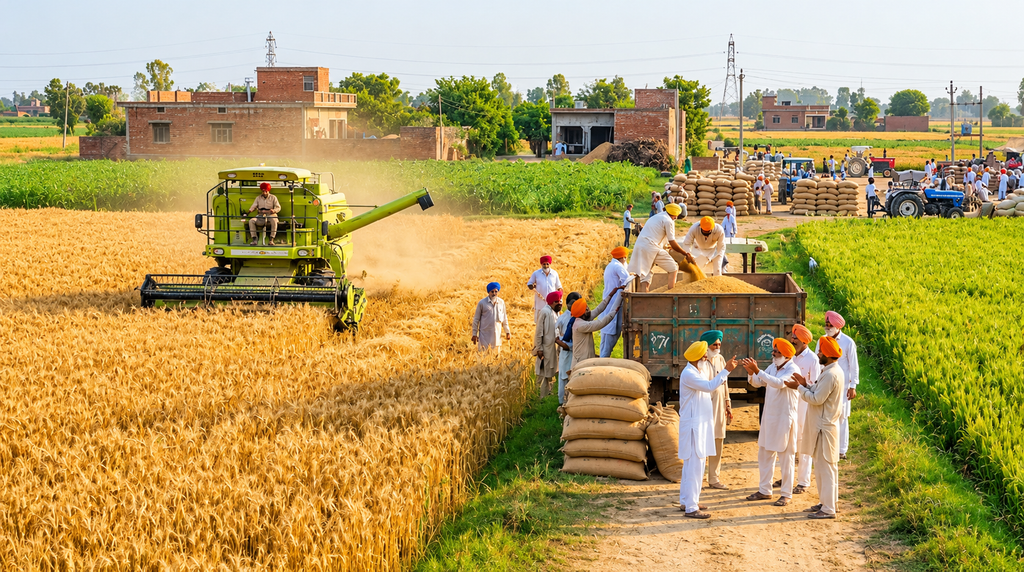
Punjab’s role in the Indian agriculture system is out of proportion to its size. A PAU extension scientist writing in The Tribune notes that with 1.53% of India’s geographical area, Punjab produced 16% of the country’s wheat, 11% of its rice, 3.4% of its cotton and 7% of its milk in 2019-20.
The state’s share of public grain stocks is larger still. Punjab contributes nearly 40% of wheat and 31% of rice to the central procurement pool, according to the Economic Survey 2025-26. Public procurement is also why farming here is so reliable. PRS reports that 72% of Punjab’s wheat and 92% of its rice were bought under public procurement in 2019-20.
That assured demand built Punjab’s prosperity, and it also locked the state into a narrow cropping pattern.
3. Employment and Rural Livelihoods
Agriculture supports more than farm households. Input dealers, mechanics, transporters, commission agents (arhtiyas), labourers and mandi workers all depend on it. Punjab’s agriculture and rural economy is therefore larger than the farm gate suggests, because each harvest cycle drives spending on machinery, fertilisers, credit, repairs and consumer goods.
Services employ a large share of the state’s workers, about 41 per cent against a national average of 30 per cent, per the Punjab Economic Survey 2024-25. Many of those jobs, in trade, transport, finance and repair, are linked to farm incomes in smaller towns and mandis. When farm incomes weaken, local demand weakens with them.
4. Farming, Markets, Rural Industry and Food Processing
Punjab’s mandi network and procurement system give farmers a degree of price certainty that most states lack. The link between farming and industry is still thin. Most grain leaves the state as raw commodity, so the value added in milling, packaging, branding and export is largely captured elsewhere.
There are signs of change. The Economic Survey 2025-26 reports that livestock’s share in agricultural GSVA has risen steadily, and Punjab holds about 8.08 per cent of India’s registered food-processing factories, ranking fourth nationally. Dairy, poultry, fruit and vegetable processing, cotton-linked textiles and farm-machinery clusters can create non-farm jobs inside villages and small towns.
Market access also affects income directly. A study of NSS data found that better market access raises farm income, with an elasticity of about 0.36 for net farm income. More efficient aggregation, storage and direct marketing channels therefore matter for farmers’ incomes.
5. Key Economic Challenges
5.1 Rising production costs and farm debt
Punjab’s yields are among the world’s highest for wheat and paddy, but profits per acre have not kept pace with costs. A 2019 Hindustan Times report cited agricultural officials noting that cereal production costs have risen 5–6% a year, pushing farmers into debt, and that the state’s agricultural GDP grew only 1.61% annually in 2005-06 to 2014-15 against an all-India 3.5%.
ThePrint reports that average monthly farm income in Punjab is about Rs 26,000, the second highest in India, yet average debt per agricultural household is Rs 2.03 lakh, the third highest, with over 54 per cent of farm families in debt. These are among the most important Punjab farmers’ problems: relatively high incomes sit alongside heavy borrowing for machinery, inputs and consumption.
5.2 Dependence on a few crops
According to ThePrint, about 90 per cent of Punjab’s kharif acreage (32.4 lakh hectares) is under paddy and 97 per cent of rabi land (36 lakh hectares) is under wheat. Paddy acreage grew from about 0.2 million hectares in 1967 to nearly 3 million hectares in 2018-19. This is a rational response to MSP and procurement incentives. It also leaves little room for crops with higher margins or lower water needs, and it exposes the state to a single policy regime.
5.3 Water resource pressure
This is the most serious long-term constraint. The Central Ground Water Board’s latest assessment, reported in the Rajya Sabha in 2025-26, shows that Punjab extracted 26.27 bcm of groundwater in 2025, a Stage of Groundwater Extraction of 156.36 per cent, the highest among all states, with 72.55 per cent of assessment units over-exploited. Annual recharge is assessed at 18.60 bcm, against 16.80 bcm of extractable resource. Nearly all of the extraction, 94.74 per cent, goes to irrigation, through more than 1.45 million tubewells.
There are early signs of improvement. The state Water Supply Department’s report indicates that extraction fell from 164 per cent in 2023 to 156 per cent in 2025, and the number of over-exploited blocks fell from 117 to 111. This is encouraging but nowhere near sustainable.
5.4 Market fluctuations and policy dependence
The assured-MSP model protects farmers from many price shocks. Crops outside procurement, such as maize, vegetables and fruit, face volatile prices and weaker marketing infrastructure. This is a major reason farmers hesitate to leave paddy and wheat. Climate shocks, including floods and heat stress, add to the risk.
6. Punjab Agricultural Economy at a Glance
| Indicator | Figure | Source and year |
| Agriculture and allied share of GSVA | 22.77% | Punjab Economic Survey 2025-26 |
| Agriculture’s share of employment | ~27% of labour force | Punjab Economic Survey 2024-25 |
| Contribution to central pool | ~40% wheat, ~31% rice | Punjab Economic Survey 2025-26 |
| Agriculture growth (constant prices) | Estimated −2.5% | PRS analysis of Punjab Economic Survey 2025-26 |
| Share of India’s registered food-processing factories | 8.08% (4th nationally) | Punjab Economic Survey 2025-26 |
| Groundwater extraction | 156.36% of annual extractable resource | CGWB, 2025 assessment |
| Over-exploited assessment units | 72.55% | CGWB, 2025 assessment |
| Average debt per agricultural household | Rs 2.03 lakh | NSS-based figures reported by ThePrint |
7. Strengthening the Economy: What Can Work
Comparison: Current model vs. a diversified, value-added model
| Dimension | Paddy-wheat dominated model | Diversified, value-added model |
| Income stability | Predictable (MSP and procurement) but with low growth | Higher potential, but dependent on market linkages |
| Water use | Very high, driving over-extraction | Lower, with maize, pulses, oilseeds, horticulture and DSR |
| Farm-gate value | Raw commodity sale | Processed, graded and branded products |
| Rural jobs | Seasonal, mostly on-farm | Year-round, with non-farm jobs in processing and logistics |
| Risk profile | Policy and climate concentrated | Spread across crops and enterprises |
| Main bottleneck | Soil and water degradation | Market access, storage and farmer risk cover |
Diversification
Diversification works only if the economics hold. Farmers need assured markets, procurement support or price-stabilisation tools, and risk cover, because they will not give up a guaranteed buyer on promises alone. Haryana, for example, launched a scheme in 2020 paying Rs 7,000 per acre to farmers who shift more than half of their paddy area to other crops. Whatever the scheme, incentives have to be credible and predictable.
Value addition and food processing
Processing clusters near production areas reduce post-harvest losses and keep value in the state. Dairy, basmati, potato, fruits, pulses and oilseeds all have potential. Cold chains, grading and testing facilities, and quality certification are the enablers.
Agricultural entrepreneurship
Farmer producer organisations (FPOs), cooperatives and agri-startups can pool small holdings, share machinery and negotiate better prices. Young, educated rural entrepreneurs can build services around farming, such as drone spraying, custom hiring, farm-to-retail supply and agri-tourism, which lowers dependence on land alone.
Rural infrastructure
Reliable power, farm-to-market roads, storage, digital market information and expanded canal irrigation underpin all of this. Canal irrigation expansion is already linked to lower tubewell dependence in some areas. Investing in irrigation efficiency, such as laser levelling, micro-irrigation and recharge structures, saves water and raises margins.
Policy coordination
Water, power pricing, procurement and credit policy all pull farmers’ decisions in different directions. Aligning them, so that sustainable choices are also profitable ones, matters more than any single scheme.
Frequently Asked Questions
Q1. How much does agriculture contribute to Punjab’s economy?
Agriculture and allied activities contributed 22.77% of GSVA in 2025-26 according to the Punjab Economic Survey, behind services (about 48%) and industry (about 29%). The sector’s importance for employment and rural spending is larger than its GSVA share.
Q2. Why is Punjab called India’s food bowl?
Punjab supplies a very large share of wheat and rice to the central pool, nearly 40% and 31% respectively according to the Economic Survey 2025-26, despite occupying about 1.5% of India’s area.
Q3. What are the biggest problems faced by Punjab’s farmers?
Rising input costs, indebtedness, dependence on paddy-wheat, falling water tables, small and fragmented holdings for many farmers, and exposure to weather shocks. Debt is a particular concern, with reported average household debt of Rs 2.03 lakh.
Q4. How serious is the groundwater situation?
Very serious. The CGWB’s 2025 assessment puts extraction at 156.36% of the annual extractable resource, with 111 of 153 assessment units over-exploited. Recent data show modest improvement from 2023, but extraction is still far above sustainable levels.
Q5. Can crop diversification raise farmers’ incomes?
It can, where there are assured markets, processing demand and risk support. Without these, farmers rationally stay with MSP-backed paddy and wheat.
Q6. What role does food processing play in rural development?
It creates non-farm jobs, reduces wastage and increases the share of final product value that stays with farmers and rural enterprises. Punjab already holds about 8% of India’s registered food-processing factories, so the base exists.
Q7. How can rural infrastructure help the Punjab agricultural economy?
Storage, cold chains, roads, power and digital market access cut losses and transaction costs, expand market choices and make diversification viable. Efficient irrigation protects the groundwater on which the system depends.
Conclusion
The Punjab agricultural economy is a national asset under strain. The Green Revolution model delivered food security, high yields and rural prosperity, and it now runs into limits of water, soil, rising costs and farm debt. Agriculture’s share of GSVA is shrinking, but it remains central to employment, rural demand and India’s grain supply. Diversification, value addition, entrepreneurship and better rural infrastructure are complements, and no one of them is enough alone. Success will depend on aligning incentives so that what is good for farmers’ incomes is also good for the state’s water and soil. The aim is to move from a grain-supplying economy to a more resilient, higher-value rural economy.