

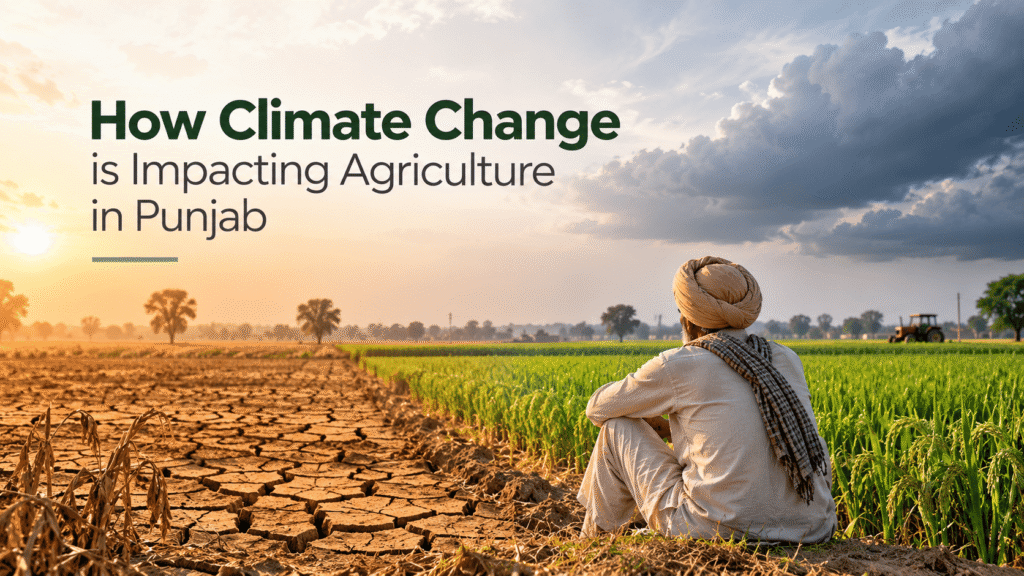
Punjab has for long been the breadbasket of India. It contributes a major share of the wheat and rice procured by the country for its food security programs. That role is in question now. Warmer springs, declining groundwater, erratic rain and smoky autumn skies are evidence of the impact of climate change on agriculture in Punjab. This post looks at each problem, and the practical steps that can help.
Why Punjab Is on the Frontline
For decades, Punjab’s farmers grew a wheat-paddy rotation supported by assured procurement and subsidized power. This system helped the Green Revolution to be successful. But paddy is a water-guzzling crop in a semi-arid region and the system is now exposed to climate stress as well as its own environmental costs. Climate change isn’t operating in a vacuum here. It adds to problems that farming practices have built up over years.
Stubble Burning and Air Quality
After the paddy harvest in October, farmers have only a short window to prepare fields for wheat. Many burn the leftover straw because it is the quickest and cheapest option.
The consequences extend well beyond the farm:
- Smoke adds fine particulate matter (PM2.5) to the air, harming respiratory health.
- Burning releases greenhouse gases, including carbon dioxide and methane.
- The share of Delhi’s pollution attributed to stubble fires varies from day to day and year to year, depending largely on wind and weather.
Burning is not a simple story of careless farmers. Many say that alternatives cost money or time they do not have. Any lasting solution has to address that.
Heat Waves and Crop Yields
High temperatures during grain filling, which occurs in March, are sensitive for wheat. An early and intense heat wave across northwestern India in March 2022 slashed wheat yields in Punjab and neighboring states, and government acknowledged lower procurement that year.
Heat stress reduces the duration of grain filling, so the grains are lighter and shriveled. Very high temperatures at nite and heat during flowering also affect rice and vegetables. Sowing earlier, planting heat-tolerant wheat varieties and choosing better planting dates can help – but these measures cannot fully insulate farmers from extreme years.
Water Table Decline
Punjab’s biggest long-term challenge may be underground. “Irrigation, particularly for paddy, is drawing groundwater more than the recharge. A vast majority of the assessed blocks in the state have been classified as “over-exploited” by the Central Ground Water Board. In many areas farmers have had to deepen tubewells again and again.
The state’s 2009 law had restricted the early paddy transplanting to ease this pressure. It postpones the transplant until monsoon rains are near, reducing evaporation losses and groundwater use. Climate change adds to the strain through higher evaporation and less reliable rain.
Erratic Monsoons
Punjab’s farmers depend on canal water and tubewells, but monsoon rain sets the tone of the season. Recent years have seen both ends of the spectrum: times of delayed or lacking rain, and periods of heavy downpours and flooding. Punjab has faced damaging floods in recent monsoon seasons with standing crops inundated in affected districts.
Scientists generally expect a warming climate to increase the intensity of heavy rainfall events, but regional patterns are complex. The practical consequence for farmers is greater uncertainty when planning sowing, irrigation and harvesting.
Soil Health Under Pressure
Soil has been affected by intensive rice-wheat cultivation, heavy use of fertilizers and burning of residue. Burning of straw kills beneficial microbes in the top layer and destroys organic matter. Also, the nutrients such as nitrogen and sulfur in the residue are wasted. Over time, lower organic carbon levels and imbalanced nutrient use can deplete soil fertility and increase input costs.
Higher temperatures also speed up the breakdown of organic matter, making it harder to build up soil carbon.
Practical Solutions
Crop Diversification
Shifting some area from paddy to maize, pulses, oilseeds, cotton, or vegetables can reduce water demand. The main barrier is economic: assured procurement for wheat and rice makes alternatives riskier. Reliable markets and price support for other crops would make diversification realistic.
Residue Management
Options include in-situ management, such as the Happy Seeder, which sows wheat directly into rice stubble, and ex-situ uses, such as biomass energy, fuel pellets, and fodder. Government subsidies for machinery and custom hiring centres have expanded access. Reports differ on how much burning has fallen, and cost and machinery availability remain concerns for small farmers.
Efficient Irrigation
Several methods can cut water use without sacrificing yields:
- Direct seeded rice, which avoids puddling and transplanting
- Laser land levelling
- Drip or sprinkler irrigation for suitable crops
- Irrigating based on soil moisture rather than fixed schedules
- Choosing shorter-duration paddy varieties that need less water
Climate Challenges and Solutions at a Glance
| Climate Challenge | Impact on Agriculture | Possible Solution |
| Stubble burning | Air pollution, loss of soil nutrients and microbes | Happy Seeder, biomass use, machinery support |
| Heat waves | Reduced wheat grain filling and yields | Heat-tolerant varieties, adjusted sowing dates |
| Falling water table | Rising pumping costs, risk of long-term water scarcity | Direct seeded rice, drip irrigation, regulated paddy timing |
| Erratic monsoons | Flood damage, sowing and irrigation uncertainty | Crop insurance, better forecasts, drainage planning |
| Declining soil health | Lower fertility, higher fertiliser needs | Residue incorporation, crop rotation, balanced fertiliser use |
Conclusion
The climate change impact on agriculture Punjab faces is neither a single crisis nor a simple one. Heat, water scarcity, unreliable rain, and soil degradation interact with long-standing farming and policy choices. Solutions exist, but they work best when farmers are supported financially and given reliable markets, rather than being asked to bear the costs alone. Diversifying crops, managing residue, and irrigating efficiently can together build resilience, but only with sustained cooperation among farmers, researchers, and policymakers.
Frequently Asked Questions
1. Why do Punjab farmers burn stubble?
The gap between paddy harvest and wheat sowing is short, and burning is the cheapest and fastest way to clear fields. Machinery and labour for alternatives add costs.
2. How do heat waves affect wheat?
High temperatures during grain filling shorten the crop’s maturity period, resulting in lighter grains and lower yields. The March 2022 heat wave is a well-known example.
3. Why is Punjab’s groundwater declining?
Extraction for irrigation, especially paddy, exceeds natural recharge. Official assessments classify many blocks as over-exploited.
4. Can crop diversification really help?
Yes, in principle, because crops like maize and pulses generally need less water than paddy. Its success depends on stable markets and fair prices for those crops.
5. What is the Happy Seeder?
It is a machine that sows wheat directly into paddy stubble without burning, leaving the residue as mulch on the field.