

Every October, as the mandis fill with the paddy harvest, a quieter question arises: at what cost to the ground beneath our feet has this crop come? The depletion of paddy water in Punjab is no longer just a caution from scientists. This is a measurable, worsening reality.
Punjab takes up about 1.5 percent of the landmass of India, yet it feeds the granaries of the country year after year. But now falling water tables in Punjab threaten that very role. This explainer breaks down the numbers, causes and solutions in plain language for farmers and the general public.
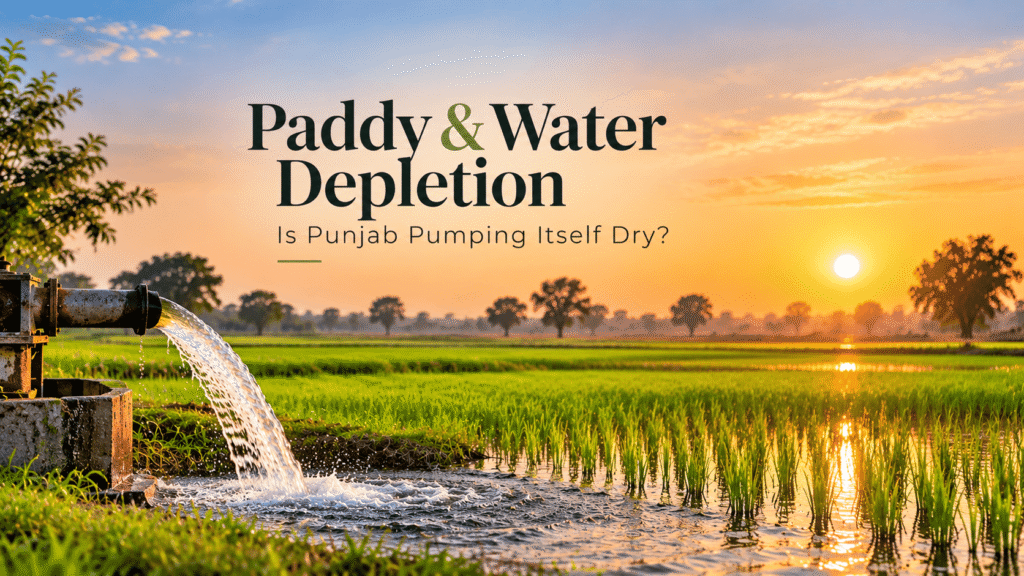
water depletion in Punjab’s paddies comes down to one imbalance. The aquifer makes up the shortfall. The state grows a thirsty crop in a parched region.
Why Did Paddy Take Over Punjab?
To understand the depletion of paddy water that Punjab is facing, we have to go back to the Green Revolution. Paddy was the safest income with guarantyd buy, assured MSP, free farm electricity and high-yielding seeds. Paddy area has increased from less than 3 lakh hectares in early 1960s to over 31 lakh hectares now.
But Punjab is a semi-arid state and paddy is transplanted in the sweltering heat of June. The crop is a natural of wetter regions so farmers compensate tubewells. This is why the exhaustion of paddy water in Punjab is better defined as policy failure and not a failure of farmers.
Paddy Water Depletion Punjab: The Numbers Behind the Crisis
Paddy is a thirsty crop. Commonly cited estimates range from 3,000 to 5,000 litres of water to produce one kilogram of rice. Multiply that by the millions of tonnes Punjab grows and the scale becomes clear.
Table 1: Paddy water depletion Punjab at a glance
| Indicator | Approximate figure | Why it matters |
| Area under paddy | 31–32 lakh hectares | The large majority of kharif area |
| Water needed per kg of rice | 3,000–5,000 litres | Far higher than maize or pulses |
| Tubewells in the state | 14–15 lakh | Most paddy is irrigated from groundwater |
| Groundwater extraction level | Roughly 155–165% of annual recharge | More is pumped than nature replaces |
| Over-exploited blocks | Over 100 of 153 | Most of the state is in the danger zone |
| Water table fall in central Punjab | About 0.5–1 metre per year | Deeper pumping, higher costs |
Figures are approximate and based on commonly cited CGWB, PAU and state reports. Please check the latest releases before quoting them.
In simple terms, the state withdraws far more water than rain and rivers return to the aquifer. That gap is what makes paddy water depletion Punjab a one-way slide unless habits change.
What Is Happening Underground?
Farmers say, first, go for paddy water depletion in central districts Punjab Borewells that discovered water at modest depths are now going much deeper. Submersibles are costly replacements for centrifugal pumps and each deepening adds to debt. Lowering water tables also increases electricity use, as it takes more energy to lift water from deeper levels.
Punjab is a slow-motion emergency, invisible on the surface but costly to every household that relies on a pump, researchers say paddy water depletion.
Why Does This Matter Right After Harvest?
The weeks after harvest are when farmers review costs and families discuss the next season. Search interest in paddy water depletion Punjab peaks now for exactly that reason. It is the moment when decisions about varieties, sowing dates and diversification are still open.
What Keeps the Problem Alive?
Several linked factors sustain paddy water depletion Punjab:
- Free power: there is no price signal that rewards saving water.
- Assured MSP and procurement: paddy carries less market risk than any alternative.
- Early transplanting: planting before the monsoon means heavy evaporation losses.
- Long-duration varieties: they need more irrigations and more weeks of standing water.
- Weak alternatives: maize, cotton and pulses lack equally dependable markets.
Solutions Already on the Table
The Punjab Preservation of Subsoil Water Act, 2009 delays transplanting until closer to the monsoon. Short-duration varieties, direct seeded rice (DSR), tensiometers and diversification incentives are also being promoted. The comparison below shows how each can reduce paddy water depletion Punjab.
Table 2: Practices that can slow paddy water depletion Punjab
| Practice | Likely benefit | What farmers should consider |
| Delayed transplanting (mid-June) | Lower evaporation, better use of monsoon | Needs timely labour and machinery |
| Short-duration varieties (e.g., PR-126) | Fewer irrigations, earlier harvest | Check yield and milling quality |
| Direct seeded rice (DSR) | Noticeable irrigation savings | Weed management is critical |
| Tensiometer-based irrigation | Saves water without hurting yield | Small upfront training needed |
| Shift to maize, basmati or pulses | Largest water saving | Market and price certainty is limited |
No single practice ends paddy water depletion Punjab alone. They work best in combination.
So, Is Punjab Pumping Itself Dry?
The honest answer: not overnight, but the direction is unmistakable. Studies have warned that if present trends continue, groundwater in large parts of the state could become too deep to pump economically within a few decades. That threatens farm incomes, drinking water and national food security alike. Paddy water depletion Punjab is a farmers’ problem, a consumers’ problem and a policy problem all at once.
What Farmers Can Do After This Harvest
The post-kharif season is the right time to act against paddy water depletion Punjab:
- Choose recommended short-duration varieties over long-duration ones.
- Try DSR on a small plot first, then scale up.
- Install a tensiometer and irrigate only when the soil needs it.
- Get laser land levelling done before the next season.
- Move part of your area to maize, basmati or pulses.
Small, steady steps by lakhs of farmers can slow paddy water depletion Punjab faster than any single scheme.
What the Public and Policymakers Should Do
- Support assured markets and MSP for crops other than paddy and wheat.
- Explore direct benefit transfers that reward farmers who save water.
- Invest in canal irrigation, rainwater recharge and wastewater reuse.
- Treat farmers as partners in solving paddy water depletion Punjab, not culprits.
Public awareness matters, because paddy water depletion Punjab cannot be solved by farmers alone.
Conclusion
Punjab fed India through its hungriest decades. Now it has to protect the water that made that possible. The question as to whether water depletion in Punjab’s paddy fields is real or not is no longer a question; the data has answered it. The real question is how fast farmers and consumers and governments will act together. “Every acre shifted, every irrigation saved, and every informed conversation helps to reduce paddy water depletion Punjab. This is the harvest time; now is the time to begin.